
Personal Branding Strategy for Founders and CEOs
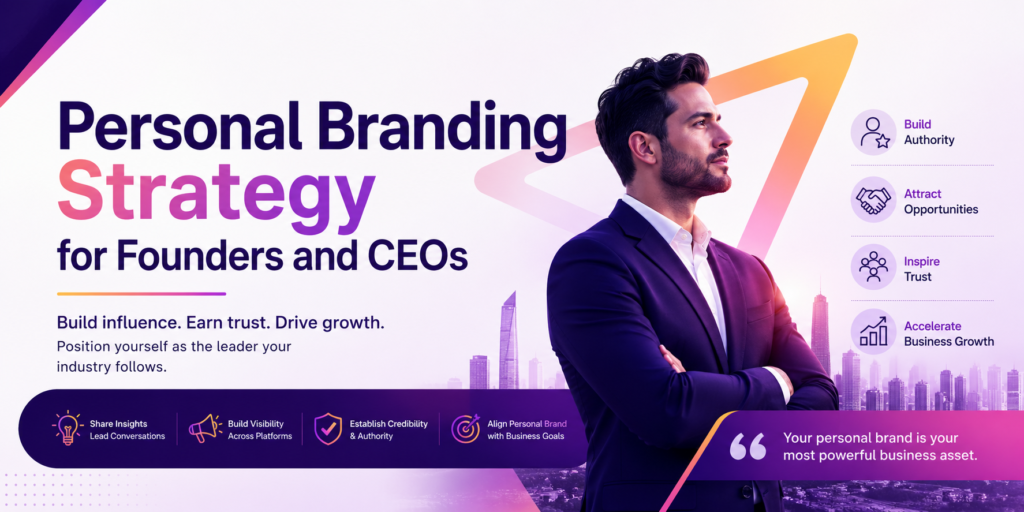
In today’s hyper-connected digital economy, founders and CEOs are no longer just business leaders—they are brand assets. The market doesn’t just evaluate your product or service; it evaluates you. Investors, customers, employees, and partners increasingly look at the individual behind the company to determine trust, credibility, and long-term vision.
A strong personal branding strategy is not about vanity metrics or self-promotion. It’s a structured, intentional approach to positioning yourself as a thought leader, industry authority, and trustworthy voice. For founders and CEOs, this directly translates into stronger business growth, better talent acquisition, improved investor confidence, and increased deal flow.
This article outlines a comprehensive, execution-ready personal branding strategy tailored specifically for founders and CEOs.
1. Define Your Strategic Positioning
Before creating content or building visibility, you need clarity on what you want to be known for.
Key Questions to Answer:
- What industry or niche do you want to dominate?
- What unique perspective do you bring?
- What problems do you consistently solve?
- What values define your leadership?
Positioning Framework:
Think of your personal brand as the intersection of:
- Expertise (What you know deeply)
- Experience (What you’ve done)
- Opinion (What you believe strongly)
Example:
A SaaS founder might position themselves as:
“A growth-focused SaaS leader specializing in scaling B2B startups through data-driven marketing.”
This clarity ensures consistency across all platforms and messaging.
2. Build a Strong Personal Brand Narrative
People don’t connect with titles—they connect with stories.
Your narrative should include:
- Your journey (failures + wins)
- Why you started your company
- Lessons learned
- Your vision for the future
Structure Your Story:
- Origin – Where you started
- Struggle – Challenges faced
- Breakthrough – Key turning points
- Mission – What drives you today
Why This Matters:
A compelling narrative:
- Humanizes your leadership
- Builds emotional connection
- Differentiates you from competitors
3. Identify Your Core Content Pillars
Random posting kills brand clarity. You need structured themes.
Ideal Content Pillars for Founders & CEOs:
- Industry Insights – Trends, predictions, analysis
- Leadership & Management – Hiring, culture, decision-making
- Business Growth – Sales, marketing, scaling strategies
- Personal Journey – Lessons, failures, wins
- Opinions & Contrarian Views – Bold perspectives
Best Practice:
Stick to 3–5 pillars maximum to maintain focus and authority.
4. Choose the Right Platforms Strategically
Not every platform deserves your attention.
Primary Platforms for Founders:
- LinkedIn – B2B authority, networking, investor visibility
- Twitter (X) – Thought leadership, quick insights
- YouTube / Podcasts – Deep authority and storytelling
- Personal Website – Central hub for your brand
Platform Strategy:
- LinkedIn → Daily visibility & professional authority
- Twitter → Real-time thoughts and engagement
- Video platforms → Long-term trust and credibility
Focus on depth over breadth—dominate 1–2 platforms instead of being average everywhere.
5. Develop a Consistent Content Engine
Consistency is the backbone of personal branding.
Content Types to Focus On:
- Short-form posts (insights, opinions)
- Long-form articles (deep expertise)
- Videos (personal connection)
- Carousels (educational content)
Weekly Content Framework:
- 2–3 value-driven posts
- 1 storytelling post
- 1 opinion/contrarian post
- 1 engagement-driven post
Key Principle:
Educate → Inspire → Engage → Convert
6. Build Authority Through Thought Leadership
Thought leadership is not about repeating common knowledge—it’s about shaping conversations.
How to Establish Authority:
- Share original insights (not recycled content)
- Analyze industry trends with depth
- Publish frameworks and models
- Take clear, strong positions
Example:
Instead of saying:
“AI is transforming marketing”
Say:
“Most companies are misusing AI in marketing by focusing on automation instead of intelligence—here’s the real opportunity.”
Authority comes from clarity + conviction.
7. Leverage Social Proof and Credibility Signals
Your personal brand strengthens when others validate it.
Key Credibility Builders:
- Client success stories
- Media mentions
- Awards and recognitions
- Testimonials
- Speaking engagements
Strategy:
Turn every achievement into content:
- Case study posts
- Behind-the-scenes stories
- Lessons from success/failure
8. Engage Actively with Your Audience
Personal branding is not broadcasting—it’s conversation.
Engagement Tactics:
- Reply to comments thoughtfully
- Ask questions in posts
- Participate in industry discussions
- Engage with other creators
Why It Matters:
- Builds community
- Increases reach organically
- Strengthens relationships
9. Align Personal Brand with Business Goals
Your personal brand should directly support your company’s growth.
Alignment Areas:
- Lead generation
- Talent acquisition
- Investor attraction
- Brand awareness
Example:
If your company targets enterprise clients:
- Share enterprise-level insights
- Discuss scalability and systems
- Highlight case studies relevant to large organizations
Avoid generic content that doesn’t tie back to business outcomes.
10. Build a Content Distribution System
Creating content is only half the job—distribution drives impact.
Distribution Channels:
- LinkedIn reposts & resharing
- Email newsletters
- Community groups
- Repurposing content across platforms
Repurposing Strategy:
- One long-form article → 5 LinkedIn posts
- One video → multiple short clips
- One insight → carousel + tweet thread
Maximize reach without creating content from scratch every time.
11. Invest in Visual and Brand Identity
Perception matters.
Key Elements:
- Professional profile photos
- Consistent color themes
- Branded templates for posts
- Clean, modern design
A polished visual identity:
- Enhances credibility
- Improves recall
- Differentiates you instantly
12. Track Performance and Optimize
You cannot improve what you don’t measure.
Metrics to Monitor:
- Engagement rate
- Follower growth
- Content reach
- Inbound leads
- Profile visits
Optimization Approach:
- Double down on high-performing content
- Eliminate low-impact topics
- Experiment with formats
13. Avoid Common Personal Branding Mistakes
1. Inconsistency
Posting randomly kills momentum.
2. Over-Promotion
Constantly selling reduces trust.
3. Lack of Originality
Reposting generic content weakens authority.
4. No Clear Positioning
Trying to appeal to everyone leads to confusion.
5. Ignoring Engagement
Not responding to your audience limits growth.
14. Scale Your Personal Brand with Systems
As a founder or CEO, time is limited. You need systems.
How to Scale:
- Content calendars
- Ghostwriting support
- Design templates
- Automation tools
Ideal Setup:
- Strategy → You
- Execution → Team/Agency
- Voice & Ideas → You
This ensures authenticity while maintaining consistency.
15. The Upally Approach to Personal Branding
At Upally, we approach personal branding as a business growth engine, not just a visibility exercise.
Our Framework:
- Brand Positioning – Define your unique voice
- Content Strategy – Build authority-driven content pillars
- Content Creation – High-quality, impactful storytelling
- Distribution – Multi-channel amplification
- Optimization – Data-driven improvements
What Makes It Different:
- Business-first approach
- Data-backed strategies
- Consistent brand voice
- Scalable execution
Conclusion: Your Personal Brand Is Your Leverage
For founders and CEOs, personal branding is no longer optional—it’s a strategic advantage.
A well-built personal brand:
- Builds trust faster than advertising
- Opens doors to opportunities
- Attracts high-quality talent and clients
- Positions you as a market leader
The key is consistency, clarity, and authenticity.
Your company might sell a product—but your personal brand sells the vision.
If executed correctly, your personal brand becomes one of your most powerful growth assets.
