
How to Define Your Personal Brand Positioning
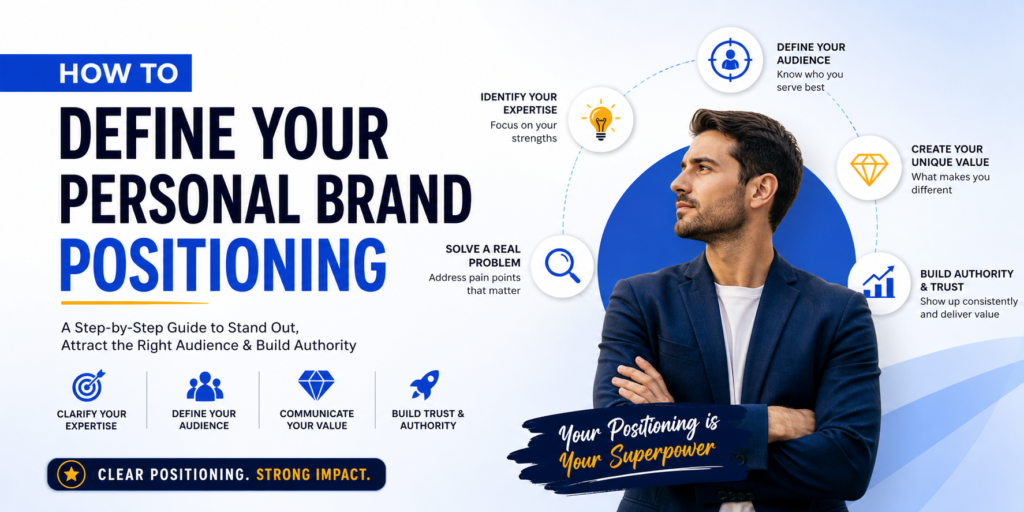
In a crowded digital landscape, visibility alone is not enough. What truly differentiates professionals, founders, and creators is clear personal brand positioning—the strategic space you occupy in the minds of your audience. Without it, your content becomes noise. With it, you become a reference point.
This guide breaks down how to define your personal brand positioning with precision, clarity, and long-term scalability.
What is Personal Brand Positioning?
Personal brand positioning is the intentional process of defining how you want to be perceived by a specific audience, in a specific domain, for a specific value.
It answers three critical questions:
- Who are you for?
- What do you stand for?
- Why should people trust you?
Think of it as your market identity, not just your personality.
Why Personal Brand Positioning Matters
Without positioning:
- Your content lacks direction
- Your audience remains undefined
- Your growth becomes inconsistent
With strong positioning:
- You attract the right audience
- You build authority faster
- You increase inbound opportunities (clients, speaking, partnerships)
In essence, positioning converts attention into trust.
Step-by-Step Framework to Define Your Personal Brand Positioning
1. Identify Your Core Expertise
Start with clarity on what you bring to the table.
Ask:
- What skills do I have proven experience in?
- What problems have I consistently solved?
- What do people already come to me for?
Pro Tip: Avoid being generic (e.g., “marketing expert”). Instead, go niche:
- “B2B SaaS demand generation strategist”
- “Personal branding consultant for founders”
👉 Specificity creates memorability.
2. Define Your Target Audience
Your positioning is incomplete without a clearly defined audience.
Segment your audience by:
- Industry (e.g., SaaS, healthcare, real estate)
- Role (founders, CMOs, freelancers)
- Stage (early-stage, scaling, enterprise)
Example:
Instead of “I help businesses grow,” say:
“I help early-stage founders build authority through personal branding.”
👉 If you speak to everyone, you connect with no one.
3. Clarify the Problem You Solve
Positioning is not about you—it’s about the value you deliver.
Define:
- What pain points your audience faces
- What transformation you enable
Example:
- Weak: “I create content”
- Strong: “I help founders turn their ideas into high-converting LinkedIn content”
👉 People don’t follow skills. They follow outcomes.
4. Define Your Unique Value Proposition (UVP)
Your UVP is what makes you different from others in your space.
Ask:
- What is my unique approach?
- What perspective do I bring?
- What makes my method effective?
Examples of differentiation:
- Data-driven approach
- Storytelling-first framework
- Industry-specific insights
👉 Your uniqueness doesn’t need to be revolutionary—just clear and consistent.
5. Establish Your Brand Pillars
Your content and communication should revolve around 3–5 core themes.
Examples:
- Personal branding strategy
- LinkedIn growth
- Founder storytelling
- Content systems
These pillars ensure:
- Consistency in messaging
- Clarity for your audience
- Scalability in content creation
6. Craft Your Positioning Statement
Now combine everything into a single, clear statement.
Formula:
I help [target audience] achieve [desired outcome] through [your method or expertise].
Examples:
- “I help B2B founders build authority on LinkedIn through strategic storytelling.”
- “I help professionals turn their expertise into a powerful personal brand.”
👉 This becomes your anchor for content, bio, and messaging.
7. Align Your Online Presence
Your positioning must reflect across all platforms:
- LinkedIn headline
- Bio descriptions
- Content themes
- Visual identity
Consistency builds recognition and trust.
8. Validate and Refine
Positioning is not static—it evolves.
Track:
- Engagement metrics
- Audience feedback
- Inbound queries
If people misunderstand what you do, your positioning needs refinement.
Common Mistakes to Avoid
- Being too broad: Leads to weak differentiation
- Copying others: Reduces authenticity
- Overcomplicating messaging: Confuses your audience
- Ignoring audience needs: Makes content irrelevant
Real-World Example of Strong Positioning
Instead of:
“I am a digital marketer”
A strong positioning would be:
“I help D2C brands scale revenue through performance marketing and conversion-focused funnels.”
Notice the clarity:
- Audience: D2C brands
- Outcome: Revenue growth
- Method: Performance marketing
How Long Does It Take to Build Strong Positioning?
Defining positioning can take 1–2 weeks, but refining it is an ongoing process.
Consistency over 60–90 days typically results in:
- Clear audience alignment
- Improved engagement
- Better inbound opportunities
Final Thoughts
Personal brand positioning is not about being famous—it’s about being known for something specific.
When done right, it becomes your:
- Competitive advantage
- Growth engine
- Trust multiplier
If you want to grow your influence, don’t just create content—create clarity.
FAQs: Personal Brand Positioning
1. What is the difference between personal branding and positioning?
Personal branding is the overall perception of you, while positioning is the strategic angle that defines how you want to be perceived in a specific market.
2. Can I have multiple personal brand positions?
You can, but it’s not recommended initially. Start with one clear positioning, then expand once you establish authority.
3. How do I know if my positioning is working?
Indicators include:
- Consistent audience growth
- Relevant inbound messages
- Higher engagement on niche content
4. Do I need a niche for personal branding?
Yes. A niche helps you:
- Stand out faster
- Build authority
- Attract the right audience
5. Can I change my positioning later?
Absolutely. As your expertise evolves, your positioning should also adapt. Just ensure the transition is clear to your audience.
6. Is personal brand positioning only for entrepreneurs?
No. It’s valuable for:
- Professionals
- Job seekers
- Freelancers
- Executives
Anyone who wants to stand out benefits from it.
